
Managed IT services provider with one team on every call
Iron Lion runs and protects the technology your business depends on. When something breaks, the same team answers, gets on the phone with your vendors and stays on it until you’re working again. Our prices are published, and the first step is a free check-up.
1978
RDI opens in Cincinnati
2006
Clients with us since
40+
Practices onboarded to Epic
Live
A person answers every call
What you can hold us to
Choosing a managed IT services provider should get you more than technical support. Here’s what Iron Lion commits to.
Prices you can see first
Pulse is $135 per user, per month for business hours support or $165 around the clock, and Radius adds security for $30. We don't bill by the hour for routine support.
We call your vendors
When your software or internet vendor says the problem is your network, we get on the call with them and stay on it until it's fixed.
One team that knows you
The same team handles every call, so nobody starts from the beginning. If you have an IT person, they keep their role and we cover what they can't.
Evidence for your insurance renewal
When your cyber insurance renewal asks about MFA, endpoint protection and backups, we document the controls so you can answer with evidence instead of a guess.
Four connected solutions for operating, protecting and advancing your business.
Pulse is our managed IT service and Radius is our managed cybersecurity service, both with published prices. Nova and Apex add AI operations, digital transformation and executive technology guidance when you need them, scoped to each client.
Managed IT services & support
We manage and patch your computers, network and Microsoft 365, back up Microsoft 365 and answer every call. $135 per user, per month for business hours support, or $165 around the clock.
LEARN MORE
Managed cybersecurity services
Strengthen your organization's security with managed detection and response, vulnerability scanning, credential monitoring and incident response from an experienced team that already understands your technology environment. $30 per user, per month added to Pulse.
LEARN MORE
AI operations and digital transformation
Put AI to work with clear governance, practical use cases and implementation focused on real business workflows, helping your organization adopt AI responsibly while measuring the time and business value created.
LEARN MORE
Executive technology & advisory
Give leadership experienced technology guidance through operational assessments, strategic roadmaps, vendor oversight and executive reporting that connects technology decisions to business priorities and long-term value.
LEARN MORECommon questions
A managed IT services provider can play an important role in helping an organization establish, maintain and document many of the technical controls commonly addressed during the cyber-insurance process. The insurer ultimately determines its own underwriting requirements, but businesses are increasingly expected to provide specific information about how their technology environment is protected.
Those questions may address controls such as multifactor authentication, endpoint detection and response, backup practices, access management, patching and incident-response planning. Simply stating that an organization takes cybersecurity seriously is different from being able to show which controls are operating and how they are managed.
Iron Lion's model connects managed IT operations through PULSE with managed cybersecurity through Radius. That creates an environment in which operational and security controls can be managed as related systems rather than independent projects.
Radius includes capabilities such as managed detection and response, vulnerability scanning and credential monitoring. Pulse provides the operational foundation around endpoints, servers, Microsoft 365, patching, backup and other infrastructure.
This combined visibility can also help when an insurance questionnaire arrives because the organization has an operating partner familiar with its technology environment and the controls that have actually been implemented.
Iron Lion does not determine whether an insurer will issue coverage or approve a claim. Its role is to help organizations operate and document the technology and cybersecurity controls that leadership, insurers and other stakeholders increasingly expect to see.
A managed IT provider can help businesses approach artificial intelligence as an operational technology decision rather than simply giving employees access to new AI tools. Effective AI adoption involves questions about data, security, governance, workflows, user access, business value and the systems AI will interact with.
Iron Lion addresses this through Nova, its AI digital transformation solution. The approach begins with governance so the organization can establish how AI should be used before expanding adoption. This is particularly important as employees may already be experimenting with public AI applications without a consistent organizational policy.
The next step is identifying practical use cases. Because Iron Lion's broader operating model provides visibility into technology systems and workflows, AI opportunities can be considered in the context of how work is actually being performed.
Nova is intended to focus implementation on measurable operational improvement rather than AI adoption for its own sake. That means evaluating where automation or AI-assisted processes can save time, improve workflows or create other identifiable business value.
Nova reports results in dollars and hours saved. This gives leadership a more useful framework for evaluating whether an AI initiative is producing a return.
For organizations already using Microsoft technologies, AI adoption may also involve Microsoft Copilot and related capabilities. The broader objective is to establish safe, governed and useful AI operations that can evolve as both the technology and the business mature.
Managed IT and cybersecurity increasingly depend on the same underlying technology environment. Endpoints, identities, Microsoft 365 accounts, servers, cloud systems and backups all have operational requirements as well as security implications. Iron Lion therefore approaches the two disciplines as connected responsibilities.
Pulse provides the managed IT operating foundation. It covers areas such as user support, endpoint and server monitoring, patching, Microsoft 365 administration, backup and recovery, cloud administration and vendor coordination.
Radius extends that environment with managed cybersecurity capabilities. These include managed detection and response, continuous security monitoring, external vulnerability scanning, dark web monitoring for compromised credentials and coordinated incident response.
The benefit of this model is operational context. The team responding to a potential security event is working with an environment already being managed and understood. That can reduce the fragmentation that occurs when an organization's IT provider and cybersecurity provider operate independently and must exchange information during an incident.
Iron Lion also emphasizes evidence. Security measures such as MFA, endpoint detection and response, backups and incident-response planning need to be implemented and documented so leadership and external stakeholders can understand the organization's security posture.
For organizations facing cyber-insurance questionnaires, compliance requirements or increased customer scrutiny, connecting cybersecurity to day-to-day IT operations can make those controls easier to maintain, document and improve over time.
Managed IT services are commonly priced according to the number of users being supported and the scope of services included. The total cost therefore depends on the size of the organization, the complexity of its environment and the level of operational coverage required.
Iron Lion publishes its starting Pulse pricing rather than requiring businesses to complete an entire sales process before understanding the basic economics. Pulse Core starts at $135 per user per month, while Pulse Complete starts at $165 per user per month. Agreements are structured on three-year terms, with fees established in writing.
The distinction between price and total value is important when evaluating managed IT services. An organization should consider what is included in the monthly service, how much internal time is currently being spent managing IT issues, whether additional project invoices are common, and how technology downtime or unresolved problems affect employees.
Businesses should also evaluate the operating model behind the price. A lower monthly rate may not represent a lower overall technology cost if essential functions are excluded or regularly billed separately.
Iron Lion's approach is designed to make managed IT spending more predictable. Pulse establishes the managed operations foundation, while additional capabilities such as Radius managed cybersecurity can be incorporated according to the organization's requirements. This allows leadership to evaluate both the monthly investment and the specific operational capabilities being provided.
A managed IT services provider takes responsibility for some or all of the ongoing technology operations that a business would otherwise need to manage internally. That can include user support, endpoint management, servers, Microsoft 365, cloud environments, patching, backup and recovery, monitoring, vendor coordination, onboarding and offboarding, and other day-to-day technology requirements.
Iron Lion approaches managed IT as an operating responsibility rather than simply a help desk function. Through Pulse, our team supports users while also monitoring and maintaining the systems those users depend on. The objective is not only to respond when something breaks, but also to reduce the number of technology problems that reach employees in the first place.
A managed IT services provider can also give leadership greater visibility into technology operations. Instead of dealing with separate vendors for individual systems or relying on internal employees to coordinate every issue, organizations can establish one accountable operating partner with knowledge of the overall environment.
Iron Lion extends that model beyond traditional IT support. Radius addresses managed cybersecurity, Nova focuses on AI operational transformation, and Apex provides executive technology advisory services. Together, these capabilities allow organizations to connect everyday IT operations with security, transformation and longer-term technology planning while maintaining a consistent understanding of the business and its technology environment.
Iron Lion provides managed IT services through Pulse, its managed technology operations offering. Pulse is designed to handle the systems, users and recurring technology responsibilities that organizations depend on every day.
Core operational capabilities include help desk support across levels 1 through 3 (business hours with Pulse Core, 24/7 with Pulse Complete), endpoint and server monitoring, Microsoft 365 administration and backup, cloud administration, vendor management, employee onboarding and offboarding, and patching. Server backup and disaster recovery is an add-on. The objective is to establish an accountable operating structure rather than leave individual employees coordinating multiple technology vendors and support issues.
Pulse Complete adds a 24/7 help desk, emergency and on-site support around the clock, Microsoft Entra multifactor sign-in and security awareness training. On either plan, you meet with us quarterly and have a named account manager.
The managed services model is also connected to Iron Lion's broader capabilities. Organizations that require more extensive cybersecurity can add Radius. Businesses looking to operationalize artificial intelligence can work through Nova, while Apex provides executive-level technology planning and advisory.
This structure allows an organization to begin with the technology operating model it needs today without treating every future requirement as a completely separate provider relationship.
Managed IT services and virtual CIO services address different levels of an organization's technology requirements, although they work best when operational and strategic decisions remain connected.
Managed IT services focus primarily on running the technology environment. Through Pulse, Iron Lion manages responsibilities such as help desk support, endpoints, servers, Microsoft 365, backup and recovery, cloud administration, patching, onboarding and offboarding, monitoring and vendor coordination.
Virtual CIO and executive technology advisory services operate at a more strategic level. Through Apex, Iron Lion works with leadership on areas such as operational maturity, technology roadmaps, vendor oversight, executive reporting and longer-term technology priorities.
The distinction matters because keeping systems running and deciding where technology should take the business are different responsibilities. An organization may have effective day-to-day IT support while still lacking a clear technology roadmap, consistent executive reporting or a structured process for evaluating future investments.
Iron Lion's model is designed to connect those layers. Apex recommendations can be informed by the technology environment the broader team works with in practice rather than being developed in isolation.
For leadership, this creates a bridge between operational technology and business planning. The organization can evaluate infrastructure, cybersecurity, AI initiatives, technology investment and future requirements through a framework that reflects both executive objectives and the realities of the existing environment.
Choosing a managed IT services provider requires looking beyond the number of services included in a package. The more important question is how the provider will operate once it becomes responsible for technology your employees and customers depend on.
Start with accountability. Determine who will actually support your organization, whether you will work with a consistent team, how issues are escalated and what happens outside normal business hours. A provider should also be able to explain how it monitors systems, manages patches, protects backups, administers cloud environments and coordinates third-party vendors.
Cybersecurity should be considered alongside IT operations rather than as a completely separate discussion. The provider should be able to explain how security controls such as MFA, endpoint detection, backup, vulnerability management and incident response fit into the environment it manages.
Pricing and scope also matter. Businesses should understand what is included, how pricing is calculated and which circumstances can create additional charges. Iron Lion publishes standardized Pulse pricing so organizations can understand the starting economics before entering the sales process.
Finally, consider whether the provider can support where the business is going, not simply where it is today. Iron Lion combines managed IT through Pulse with Radius cybersecurity, Nova AI operational transformation and Apex executive advisory so organizations can address operations, protection and strategic technology decisions through a coordinated team.
Iron Lion works with organizations that need a more structured approach to technology operations, managed cybersecurity services and strategic technology planning. The company's strongest industry experience includes healthcare, manufacturing, law firms and legal services, as well as other professional and operationally complex organizations.
Iron Lion has supported Bon Secours Mercy Health affiliate practices since 2010, including Epic EHR onboarding. That work has included ongoing support as well as technology requirements associated with Epic EHR onboarding. Iron Lion has also worked with Custom Distributors, a Cincinnati appliance distributor, since 2006.
These industries can have very different technology requirements, but they share a need for reliable operations, security and accountability. Healthcare organizations may need to support clinical applications, users and complex technology systems. Manufacturers and distributors depend on systems that keep operational processes moving. Law firms and professional services organizations rely heavily on secure access to business-critical information and applications.
Iron Lion's model is built around those underlying operational requirements rather than a one-size-fits-all collection of tools. Pulse handles managed IT operations, Radius addresses cybersecurity, Nova supports AI operational transformation and Apex provides executive technology guidance.
The company is rooted in Greater Cincinnati and Columbus and supports clients beyond those markets. Organizations considering Iron Lion should evaluate fit based on their operating requirements, technology complexity and need for an accountable technology partner.
Organizations evaluating a managed IT services provider should consider how the provider operates, who will be responsible for the environment and whether the relationship can support both immediate technology requirements and longer-term business change.
Iron Lion's model is built around four connected capabilities. Pulse manages day-to-day IT operations. Radius provides managed cybersecurity. Nova helps organizations implement AI within a governed operational framework. Apex provides executive technology advisory and planning.
This structure is intended to reduce fragmentation. Rather than separating IT support, cybersecurity, AI initiatives and executive technology planning among providers that may have limited visibility into one another's work, organizations can work with a team that understands the broader technology environment.
Continuity is another important part of the model. Iron Lion emphasizes named, experienced people who understand the client's systems, users and operating requirements. Iron Lion's client relationships include organizations that have worked with the team for many years, supporting the company's emphasis on long-term operating relationships rather than short engagements.
Pricing is also published. Pulse Core starts at $135 per user per month and Pulse Complete at $165 per user per month, with pricing established in writing on three-year agreements.
Ultimately, Iron Lion is not simply an outsourced help desk, but an operating technology partner designed to run, protect and progressively improve the technology behind the business.
Case studies

Bon Secours Mercy Health: more than 40 affiliate practices onboarded to Epic

A lighting manufacturer's acquisition: the IT gaps we found and the 24/7 help desk we built

Goldsboro Pediatrics: no downtime and no compromised accounts through the Exchange attacks

What does managed IT cost, and what comes off your desk for the price?
Iron Lion in 60 seconds
What happens when an alert comes in at 2:47 a.m.
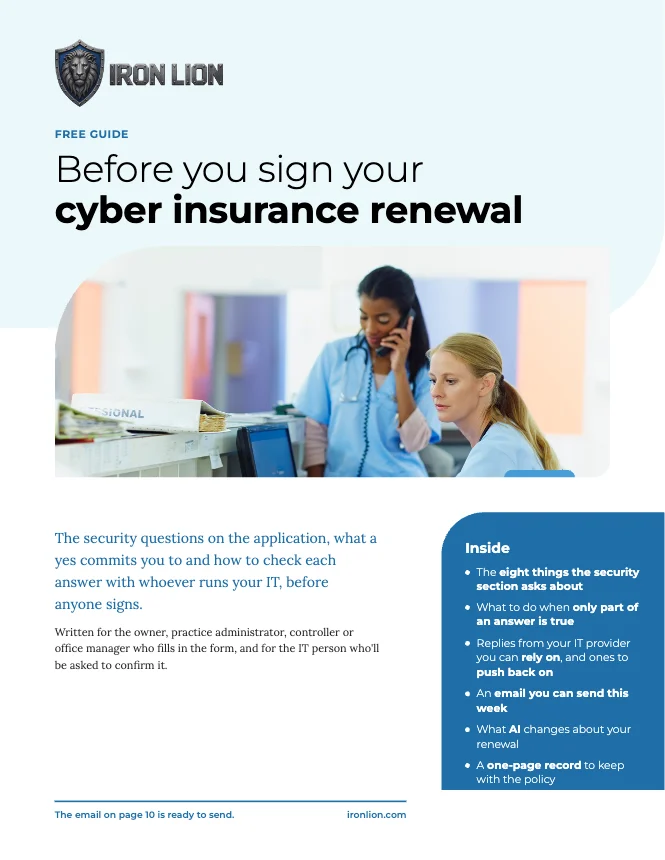
FREE GUIDE FROM IRON LION
Renewing your cyber insurance this year?
Read this before anyone signs the form. It covers the eight groups of security questions on most applications and what a yes commits you to.
- What each question is really asking
- What to check with whoever runs your IT
- A one-page record to keep with the policy