IT for healthcare organizations
It’s 8 a.m., the schedule is full and the practice management system won’t load. With Iron Lion, you make one call. Our team gets on the line with your EHR, billing or internet vendor and stays on it until your front desk is working again.
IT for healthcare from Pulse starts at $135 per user a month.
2010
Supporting Bon Secours Mercy Health practices since
40+
Practices onboarded to Epic
Live
A person answers every call
BAA
Available for healthcare clients
IT for healthcare from one team that takes every call
When the EHR won’t load or the internet drops, someone at the practice usually spends the morning on hold while each vendor says it’s someone else’s problem. With Iron Lion, one team takes the call, works with your vendors and stays on it until you’re back up and running. If you have an IT person, we work alongside them.

Epic support and onboarding
We've onboarded more than 40 Bon Secours Mercy Health affiliate practices to Epic, setting up the sign-ins, computers and network each practice needed and supporting go-live.

Help desk hours that fit your clinic
Pulse Core covers 7 a.m. to 7 p.m., Monday to Friday. Pulse Complete answers around the clock for evening and weekend hours. A person answers every call, and an engineer starts on critical issues within 15 minutes.

HIPAA-aligned security controls
Every Pulse plan includes a managed firewall, antivirus, patching, multifactor sign-in and Microsoft 365 backup with email threat protection. A business associate agreement is available.

We call your vendors
When your EHR, billing, clearinghouse or internet vendor blames your network, we get on the call and stay on it until it's fixed, whoever's equipment turns out to be at fault.
What healthcare organizations get from Iron Lion
Here’s what changes when Iron Lion runs IT for your practice.
-
One call when something breaks
Your staff call one team for the EHR, printers, sign-ins and the internet. We work out which vendor owns the problem.
-
Epic experience
We’ve supported Bon Secours Mercy Health affiliate practices since 2010 and onboarded more than 40 of them to Epic.
-
Maintenance around your schedule
We plan patching and changes around clinic hours, so exam-room computers aren’t restarting during appointments.
-
Security in every plan
Firewall, antivirus, patching and multifactor sign-in come with Pulse. Radius adds threat detection and response around the clock for $30 per user a month.
-
Help with your cyber insurance renewal
Bring your cyber insurance application to a free review, and a cybersecurity expert will go through it with you. You don’t need to send it to us.
-
The same support at every site
Every location gets the same standards and the same team, so a problem at one office is handled the way it would be at another.
What it costs
Pulse Core | $135 per user a month
Help desk 7 a.m. to 7 p.m., Monday to Friday, plus security in every plan.
Pulse Complete | $165 per user a month
Help desk and emergency support around the clock, plus security training for your staff.
Radius | $30 more per user a month
Threat detection and response around the clock, quarterly outside scans and dark web monitoring.
Prices are on a three-year agreement with a 20-user minimum.
Common questions about IT for healthcare
Yes. Iron Lion’s healthcare experience includes supporting multiple sites and working inside larger health system environments. We have supported Bon Secours Mercy Health since 2010, including onboarding more than 40 affiliate practices to Epic and supporting their computers, sign-ins and staff day to day. IT for healthcare across several sites is different from supporting one office. Each location may have different hardware, a different network, different applications and its own history of how things were set up. The larger organization usually needs every site to follow the same standards for sign-ins, security, documentation and support. We give every location the same standards and the same team, so a problem at one office is handled the way it would be at any other. Computers are set up the same way, patching runs on the same schedule, and security in every plan applies at every site. When a hospital or health system has its own IT, Epic or security people, we work within the way they already operate. We coordinate with them and take on the parts they want help with, rather than replacing people who are doing the job well. Every client gets a named account manager and quarterly meetings, so the larger organization has one person to go to and a regular review of how each site is running.
Yes. Iron Lion has supported Bon Secours Mercy Health affiliate practices since 2010 and has onboarded more than 40 of them to Epic. When an affiliate practice joins a health system’s Epic environment, the work involves much more than installing software. Our part is the local IT for healthcare work at the practice. We work with the health system’s Epic team, set up the practice’s computers to their requirements, set up staff sign-ins, check that the network is ready and support the practice through go-live. We plan that work around clinic hours, so the practice keeps seeing patients while it is being prepared. This matters most when a practice is joining a larger health system. The health system usually has its own security standards, sign-in requirements, technical specifications and change procedures, and the practice has to meet them while it keeps running. Our role complements the health system’s own Epic team. The health system stays responsible for Epic itself, and we handle the computers, network and sign-ins at the practice so it is ready on the day. After go-live, we can keep supporting the practice day to day through Pulse. That means the people who set up the practice are the same people who answer when something goes wrong, and they already know how it was configured and how it connects to the health system.
Backup and disaster recovery matter more in healthcare than in most businesses, because a system that won’t come back can stop patient care. IT for healthcare has to cover both the data you use every day and the servers your practice runs on. Every Pulse plan includes Microsoft 365 backup, so email, OneDrive and SharePoint can be restored if something is deleted, damaged or locked by ransomware. Servers need their own backup. Server backup and disaster recovery is an add-on at $179 per protected server a month. It includes the backup appliance, one year of retention and recovery testing. Recovery testing matters because a backup that finishes every night doesn’t prove you can restore from it. You also need to know what is protected, how each system would be brought back, who does the work and how long it would take. Testing answers those questions before an emergency instead of during one. Not every system in a practice carries the same weight. The EHR, the practice management system and anything patients touch usually have to come back first, while some administrative systems can wait. During the free IT check-up, we go through which systems you can’t run without and how quickly they have to return, so your backup plan matches how the practice actually works.
Controlling who can get into which systems is a basic part of healthcare IT. Clinicians, front-desk staff and billing staff all need access to different things, and that access has to change as people join, move into new roles or leave. Every Pulse plan includes multifactor sign-in, so a stolen password on its own isn’t enough to get into your systems. Pulse Core uses Duo and Pulse Complete uses Microsoft Entra. We set up sign-ins when someone joins the practice, change them when their role changes and remove them when they leave, so old accounts don’t stay open. We also manage the computers people sign in on, with antivirus and patching on every device. Each person with their own sign-in counts as one user, even if staff share a computer at the front desk. Sign-ins also matter during Epic onboarding. When a practice joins a health system’s Epic environment, we set up staff sign-ins and computers to the health system’s requirements and coordinate with its team. Radius adds dark web monitoring, so we hear when staff passwords turn up in a breach and the person can change them. Conditional access and privileged access management aren’t included in Pulse or Radius. If your practice needs them, we’ll tell you during the free IT check-up and explain what it would take.
Iron Lion takes over a practice’s IT in stages, planned around clinic hours, so patients keep being seen while we do it. Onboarding takes about four weeks, and there is no setup or onboarding fee. First we learn how your systems, computers, network and vendors fit together, and which things break most often. We document what we find, so nothing depends on one person’s memory. If you have a compliance lead, we talk with them early, so we understand your requirements before we change anything. Then we take on day-to-day healthcare IT a piece at a time. This matters because ordinary IT work has different consequences in a clinic. Taking an exam-room computer offline, changing someone’s sign-in or working on the network at the wrong time can hold up clinicians and appointments. Patching, computer replacements and network work are scheduled outside appointments. Larger events, like moving onto Epic, get their own plan. We have onboarded more than 40 Bon Secours Mercy Health affiliate practices to Epic, including sign-ins, computer setup, network checks and go-live support. If you have an IT person, we agree who does what before we start, and they keep their admin access. If you’re moving from another provider, we work with them on the handover. You also get a named account manager from the first day.
Iron Lion’s healthcare work includes community health centers and Federally Qualified Health Centers. Primary Health Network, a community health center network in Pennsylvania and Ohio, is one of our clients. These organizations often carry a heavy mix of operational and compliance demands with limited staff and budget. When technology goes down, it slows clinicians and front-desk staff, and it can delay care for patients who may not have another place to go. Community health centers get the same healthcare IT service as any practice, through Pulse: a help desk staff can call, management of computers, network, servers and Microsoft 365, patching planned around clinic hours, and security in every plan. Pulse starts at $135 per user a month, with no setup or onboarding fee. We start by learning how the center works and which systems break most often. Then we take over day-to-day IT in stages, over about four weeks, so clinics keep running while we do it. Work that could interrupt care is scheduled outside clinic hours. For centers with several sites, every location gets the same standards and the same team, which removes unnecessary differences between clinics and gives staff the same support wherever they work. A business associate agreement is available, and every client gets a named account manager and quarterly meetings.
Healthcare IT has to support the technical side of HIPAA, and every Pulse plan includes controls that do that. Each plan includes a managed firewall, antivirus on every computer, patching, multifactor sign-in, and Microsoft 365 backup with email threat protection. Pulse Core uses Duo for multifactor sign-in, and Pulse Complete uses Microsoft Entra and adds security awareness training and phishing testing for staff. Radius adds threat detection and response around the clock, quarterly scans of your network from the outside and dark web monitoring, so we hear when staff passwords show up in a breach. Server backup and disaster recovery is available as an add-on at $179 per protected server a month, including recovery testing. A business associate agreement is available for healthcare clients. These controls cover different parts of the environment. Multifactor sign-in and managed accounts help control who can get into your systems. Antivirus and patching protect the computers staff use every day. Backups help you recover when something is deleted, damaged or locked. IT services on their own don’t make a practice HIPAA compliant. HIPAA also covers policies, staff training, physical security and other responsibilities that sit with the practice. We describe what we provide as HIPAA-aligned controls, and we’ll tell you plainly what is covered and what isn’t.
In most offices, a computer that won’t start slows one person down for an afternoon. In a medical practice, the same failure can hold up an exam room, delay a check-in or stop a claim from going out. That difference changes how healthcare IT has to be run. Maintenance and patching have to be planned around clinic hours, not dropped into the middle of a morning schedule. Problems with the EHR, the practice management system, the billing software or the clearinghouse usually involve an outside vendor, so someone has to get on the phone with that vendor and stay on it until the problem is fixed. Clinicians and front-desk staff can’t wait in a queue while patients sit in the waiting room. Patient information also raises the stakes on security. Sign-ins, computers and email all need to be protected, and the practice needs backups it can restore from when something goes wrong. Iron Lion plans changes around your schedule, answers the call when something breaks and works with your vendors until you’re running again. Pulse Core covers 7 a.m. to 7 p.m., Monday to Friday, and Pulse Complete adds a help desk around the clock. If you already have an IT person, we work alongside them, and they keep their admin access.
IT for healthcare covers the everyday IT any practice needs, run with patient care in mind. With Iron Lion’s Pulse managed IT, that means a help desk your staff can call, management of your computers, network, servers and Microsoft 365, patching planned around clinic hours, and security in every plan: a managed firewall, antivirus, multifactor sign-in and Microsoft 365 backup with email threat protection. Pulse Core covers the help desk from 7 a.m. to 7 p.m., Monday to Friday, for $135 per user a month. Pulse Complete covers it around the clock for $165. Radius adds threat detection and response around the clock, quarterly outside scans and dark web monitoring for $30 more. Prices are per user a month on a three-year agreement. The difference matters because a technology problem in a clinic reaches patients quickly. What makes IT for healthcare different is the vendors. When the EHR, billing system or clearinghouse stops working, we get on the call with that vendor and stay on it until your front desk is working again. Epic is part of the work too. We have onboarded more than 40 Bon Secours Mercy Health affiliate practices to Epic, setting up sign-ins and computers and supporting go-live. A business associate agreement is available.
Iron Lion supports medical practices, provider networks, hospitals and community health organizations. That work includes day-to-day IT, Epic onboarding, computer and sign-in management, security, backup and recovery. Our largest healthcare relationship is with Bon Secours Mercy Health. It began in 2010, and we have onboarded more than 40 of its affiliate practices to Epic. We work with the health system’s Epic team, prepare each practice and support go-live, then keep supporting the practice day to day. The healthcare organizations we support also include Orthopedic One, Orthopedic One Easton Surgery Center, Primary Health Network, Adams County Regional Medical Center, HealthPoint Family Care, WinMed, Goldsboro Pediatrics, North Community Counseling Centers and Interventional Spine Specialists. Medical device and clinical technology clients include AtriCure and Palarum. When attackers exploited Microsoft Exchange servers worldwide in 2021, our team kept Goldsboro Pediatrics running with no downtime, and follow-up scans confirmed that no accounts had been compromised. That experience matters because healthcare IT involves more than standard office support. Clinic schedules, EHR requirements, sign-ins, security, multiple sites and patient-facing systems all affect how changes have to be planned. We bring that understanding to every practice we support, and a business associate agreement is available.
Iron Lion in 60 seconds
What happens when an alert comes in at 2:47 a.m.
FREE GUIDE FROM IRON LION
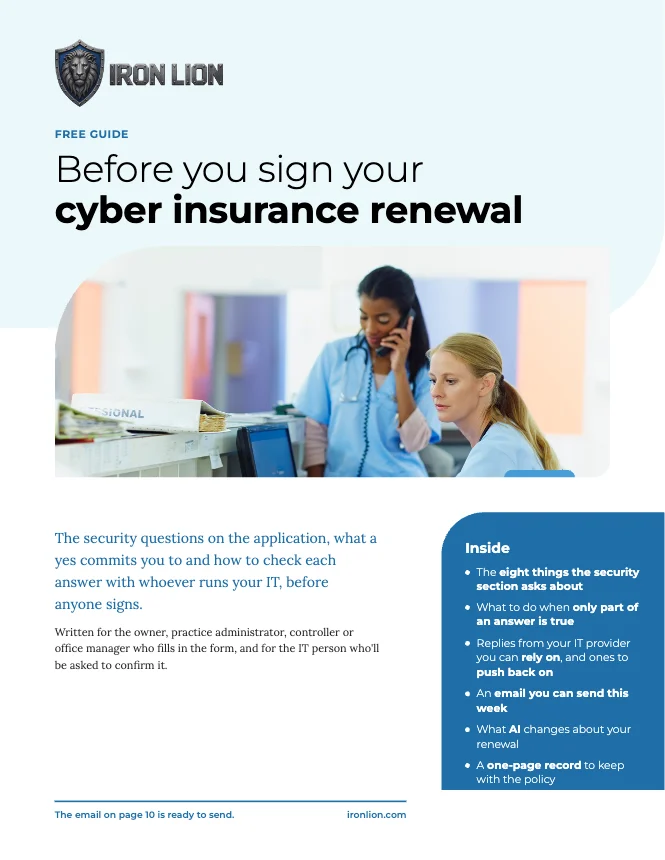
Renewing your cyber insurance this year?
Read this before anyone signs the form. It covers the eight groups of security questions on most applications and what a yes commits you to.
- What each question is really asking
- What to check with whoever runs your IT
- A one-page record to keep with the policy